
Decato vs Virtual Staging AI after the photo has done its job
Virtual Staging AI does one thing and does it in about ten seconds: it furnishes a photograph of an empty room so a listing sells. It is priced by the photo and built for agents. Decato is not a faster version of that — it works from a floor plan, and what it hands back is a room specified down to the price of each piece.

Decato
Furniture chosen to be bought, not to photograph well in an empty listing.
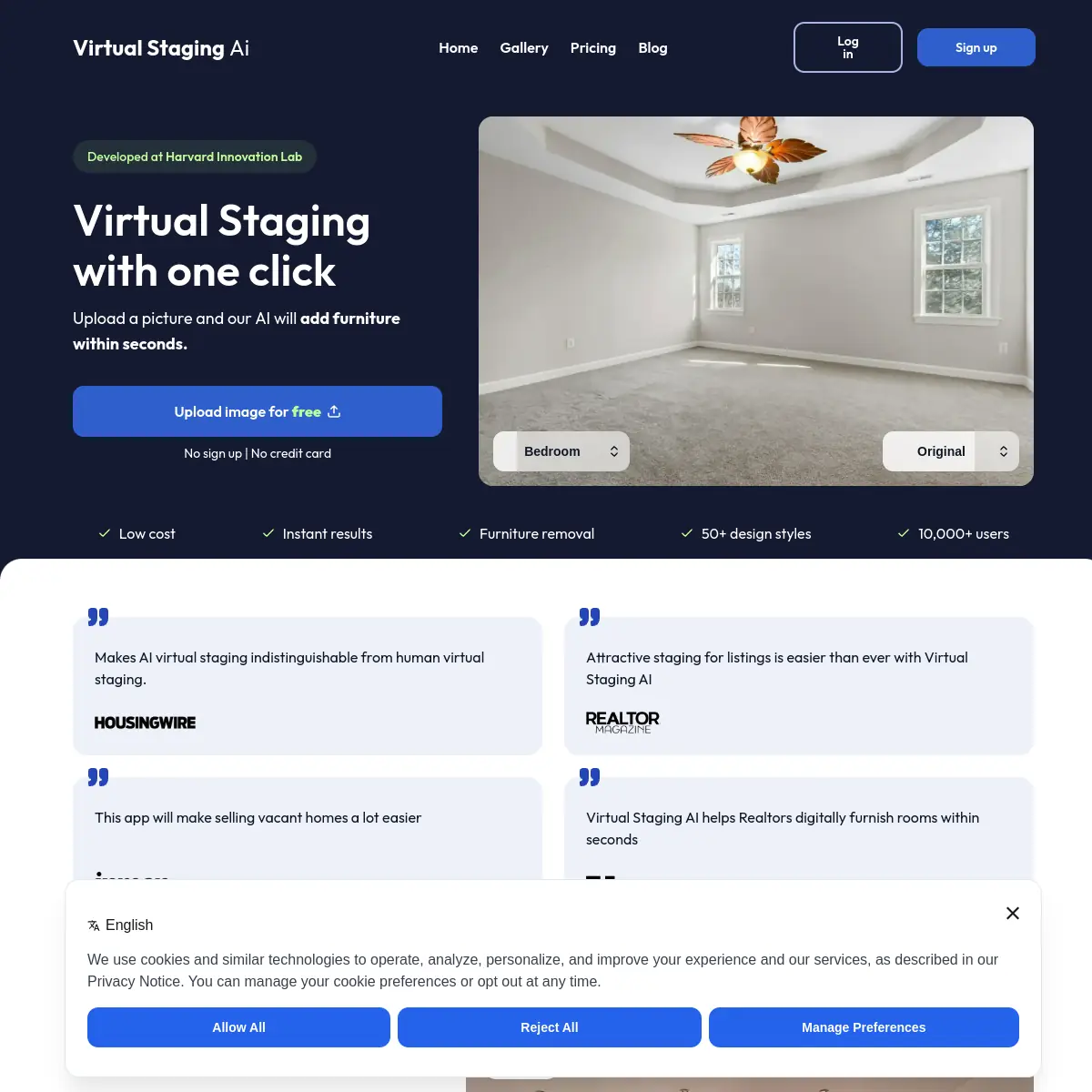
A single-purpose staging tool for property photography. Upload a picture of an empty room and it comes back furnished in roughly ten seconds, with unlimited re-renders, priced per photo and tiered for agents, brokerages and photographers.
Built for the case where somebody buys the furniture. Decato needs a dimensioned plan, sources in-stock products against it, rejects what will not physically fit, and hands back a priced spec alongside the render rather than instead of one.
If a room needs to look furnished in a listing this afternoon, Virtual Staging AI is both faster and dramatically cheaper. If someone is going to buy the furniture in the picture, staging cannot tell you what it is, what it costs or whether it fits.
What each one does
Needs a measured plan to begin
Furnishes a photo of an empty room
The furniture shown is furniture you can order
Rejects a piece that will not fit the room
Produces a priced list for procurement
Keeps a running total for the room
Seconds per room
Unlimited re-renders of the same room
The work survives as a project, not a file
Works on Windows or in a browser
Staging runs in a browser; Decato does not
Neither tool wins everywhere
Virtual Staging AI does things Decato cannot do at all. Knowing exactly where the line falls is more useful than being told one tool is better.
- Answers the question staging never has to: what is that furniture, and will it fit
- Nothing in the render is a prop — every item is orderable, priced and in stock
- Costed while it is built, so the room is affordable before anyone falls in love with it
- Billed by the room rather than by the photo, because the deliverable is not a photo
- About ten seconds a room, against the time it takes to draw a plan in Decato
- Far cheaper per image — the top tier works out well under a dollar a photo
- Unlimited re-renders and downloads, so a room can be restaged until it looks right
- Runs in a browser and is built for listing volume, where Decato is a Mac app
What each one costs
- Free$0Unlimited planning on your own AI key; billed by room, never by photo
- Pro$20/moFull sourcing and 25 renders — a render here is a specified room, not a staged shot
- Max 5x$100/moSame capability, more rooms in a month
- Max 20x$200/moSame capability again, for studio volume
- Basic$16/mo6 photos a month
- Standard$19/mo20 photos a month — "for agents"
- Professional$39/mo60 photos a month
- Enterprise$79/mo150 photos a month, for teams and brokerages
Virtual Staging AI is cheaper than Decato on every tier, and per photo it is not close — its upper plans land well under a dollar an image, with yearly billing cutting that further. That is the correct price for what it sells, which is pictures. Decato is free to download and charges for render volume, and what you get for it is a specified room rather than an image of one.
Both price lists checked August 2026If you move across
Staging keeps doing what it does well. This is about the second, separate job that starts when someone intends to buy the furniture in the picture.
- The staged look that sold the property, as the direction the real room is sourced toward
- A floor plan of the same room — the input staging never needs and Decato cannot start without
- A budget for furnishing it, which is a question staging is never asked
- Staged photographs. Decato has no photo pipeline; images made there stay there
- Subscriptions — the two are billed separately, with no migration path
- Listing work. If the job is selling a property, staging is the right tool for it
Compare Decato against the next closest workflow.
If this page is close but not exact, use the routes below to compare Decato against staging-first, retail-first and render-first alternatives with the same decision lens.
Decato vs REimagineHome
Both source real furniture. REimagineHome fits it to a photo; Decato fits it to a dimensioned plan.
Service-outputDecato vs BoxBrownie
BoxBrownie sells edited images per job. Decato sources a room into a priced specification.
Retail-workflowDecato vs Wayfair
Wayfair plans your room and fills its own cart. Decato checks the fit and hands over a spec.
Consumer-visualizationDecato vs IKEA Kreativ
Kreativ furnishes your scanned room from IKEA. Decato adds Wayfair, checks fit and writes a spec.
Most comparison tools judge the screenshot. Designers still have to deliver the room.
Decato is optimized for the step after concept approval: matching real products, checking fit, keeping the room inside budget and turning the output into a defendable package instead of a render to reverse-engineer.
Common questions
Is Decato a Virtual Staging AI alternative?
Not really, and it is worth being plain about it. Virtual Staging AI sells staged listing photos by the month; Decato sells a specified room. If you came looking for cheaper staging, Decato is the wrong tool and considerably more expensive per image.
Can virtual staging furniture be bought?
Not through Virtual Staging AI — no retailer links or product sourcing are advertised (Checked August 2026). Staging furniture exists to make a room read well in a photograph. Decato works the other way round: it starts from products that are real and in stock, and the render is assembled from them.
We stage listings and also design interiors. Do we need both?
Probably, because they answer different questions. Staging makes a property sell; specification makes a room buildable. Nothing transfers automatically between them, but a brief, a budget and a floor plan carry across, and Decato picks up once a client has approved a direction and wants the room itself.
Why is Decato slower?
Because it will not start without a dimensioned plan, and everything after that depends on having one. Drawing or importing it is the cost of a fit check, a real product list and a priced spec. Staging skips the plan, which is exactly why it takes ten seconds and cannot tell you whether the sofa fits.