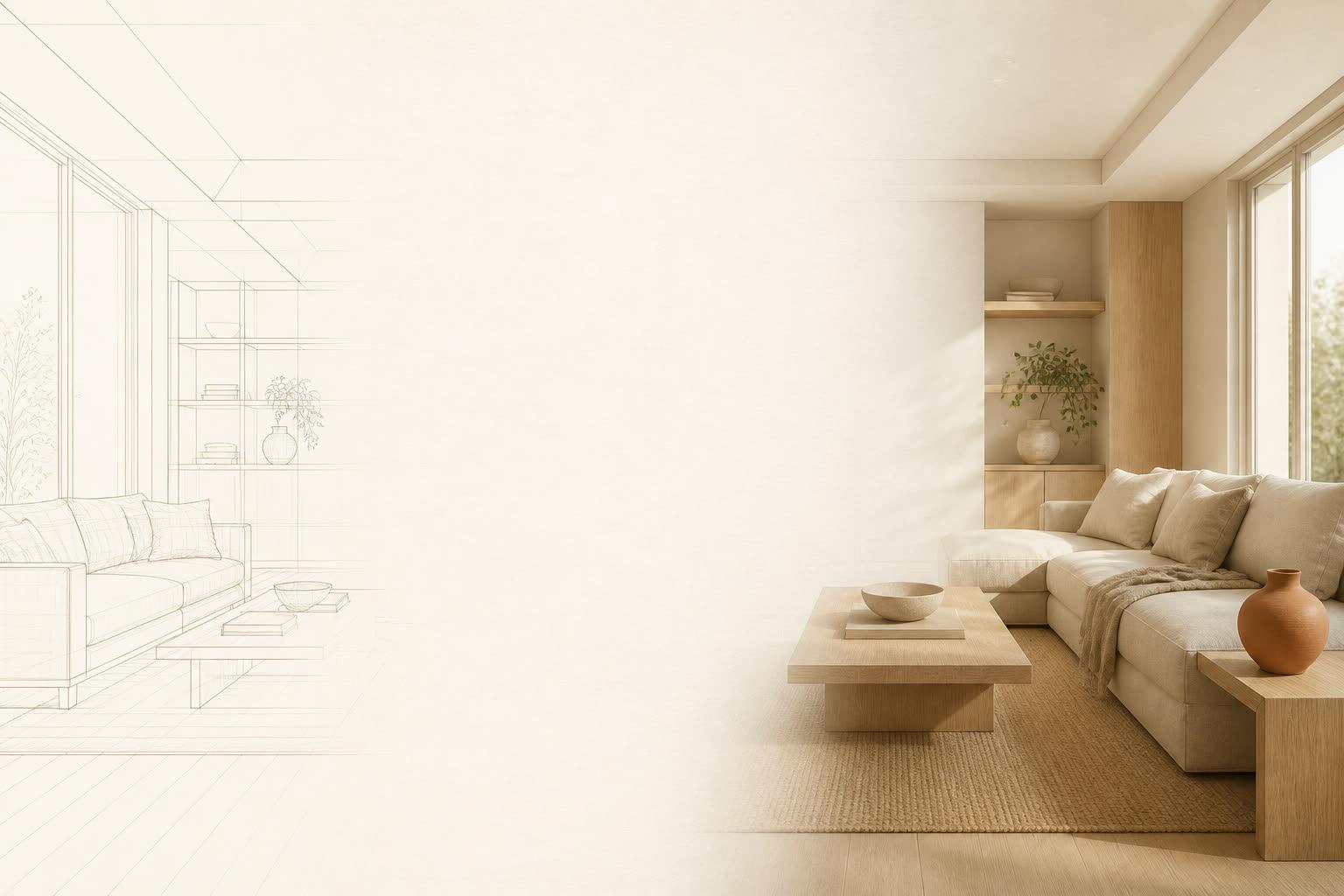
Decato vs Interior AI when the furniture has to be real
Interior AI restyles a photograph of a room into thousands of variations, and it is genuinely fast at it. But the furniture in those images is generated, not sourced — their own FAQ warns that a chair may come back with too few legs. Decato starts from a floor plan and every piece it places is a product you can buy.
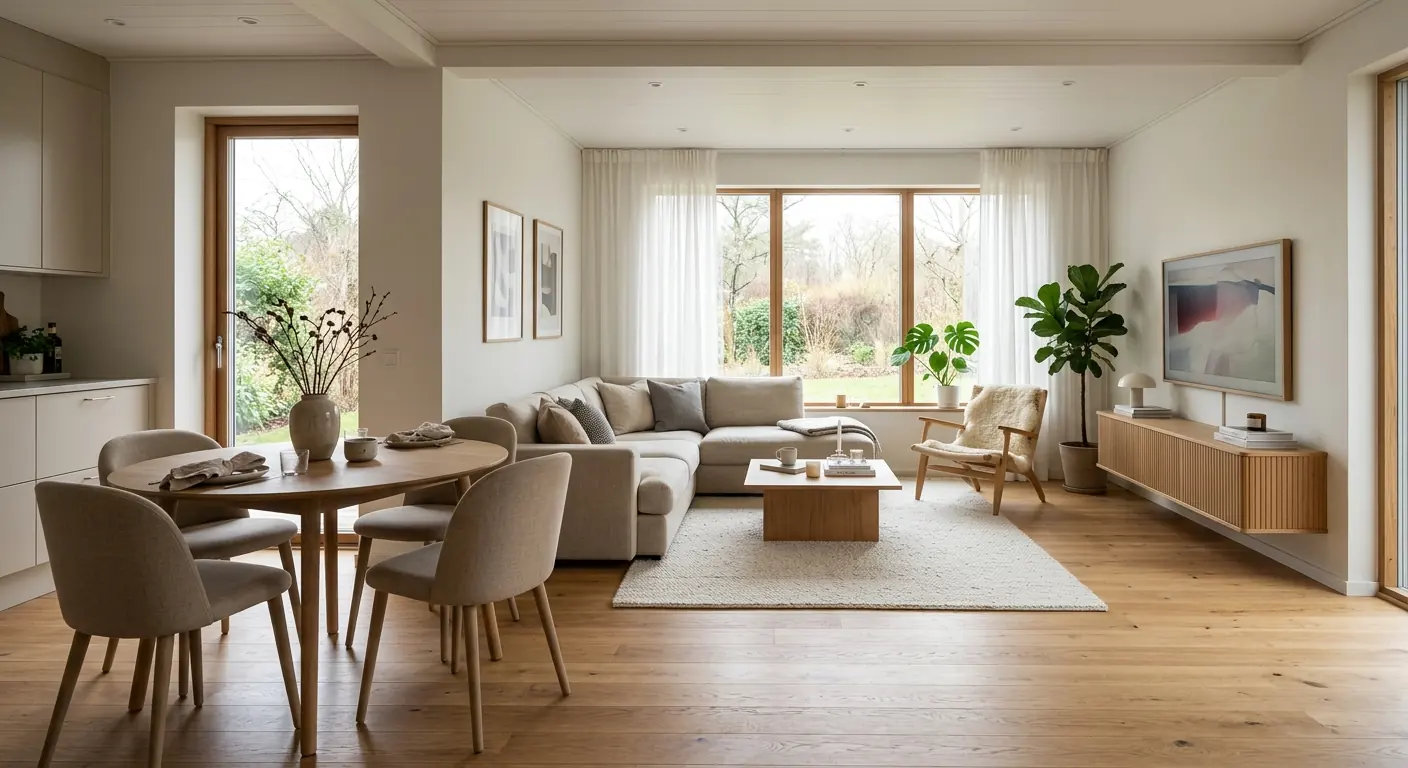
Decato
Every chair here has four legs, because none of them were generated — they were sourced.

A high-volume ideation tool. Feed it a photo, a sketch or a SketchUp screenshot and it returns photoreal restylings, virtual staging and walkthroughs — thousands of designs a month on the entry tier, tens of thousands higher up.
A converging tool where Interior AI is a diverging one. It takes a plan and a budget, settles on one room, and proves it: real products, checked against the walls, priced line by line into a spec a client can approve and a supplier can fill.
If the question is still "what could this room look like", Interior AI answers it faster and in more directions than Decato ever will. If the question has become "what exactly do we buy, and does it fit", the generated furniture in an Interior AI image cannot answer it.
What each one does
Needs a measured plan to begin
Works from a photo, sketch or model view
The furniture exists and can be ordered
Rejects a piece that will not fit the room
Produces a priced list for procurement
Keeps a running total for the room
Thousands of style variations
3D walkthroughs
The work survives as a project, not a file
Works on Windows or in a browser
Interior AI is browser-only; Decato is macOS
Neither tool wins everywhere
Interior AI does things Decato cannot do at all. Knowing exactly where the line falls is more useful than being told one tool is better.
- Built to converge rather than to widen — one room, settled, instead of a thousand more options
- No chair comes back with the wrong number of legs, because no chair here is generated
- A budget you can hold to, because every item carries a real price rather than a look
- The output survives the meeting: a spec to order from, not an image to re-source later
- Enormous variation volume — a thousand to twenty-five thousand designs a month
- Accepts sketches and SketchUp screenshots, neither of which Decato takes
- Virtual staging and 3D walkthroughs, which Decato does not produce
- Runs in a browser on any machine, where Decato is a Mac app
What each one costs
- Free$0Unlimited planning on your own ChatGPT, Claude or Gemini key
- Pro$20/moEvery feature and every supported store, with 25 renders
- Max 5x$100/moThe same plan at 125 renders
- Max 20x$200/moThe same plan at 500 renders
- Pro$49/mo$29/mo billed yearly — 1,000 designs a month
- Premium$99/mo$49/mo billed yearly — 5,000 designs a month
- Ultra$199/mo$99/mo billed yearly — 25,000 designs a month
Interior AI is dearer per month at entry and far cheaper per image, because it sells images by the thousand. Decato is free to download and its paid tiers buy render volume, not features. If the work is generating options, Interior AI wins on unit economics by a wide margin. If the work ends in a purchase order, Interior AI is not priced for it because it does not do it.
Both price lists checked August 2026If you move across
These sit at opposite ends of one project — exploration and specification — so this is less a migration than a hand-off from the wide phase to the narrow one.
- The variation a client picked out of the hundred Interior AI generated, as the brief
- A floor plan of the room, which Interior AI has no use for and Decato cannot work without
- The budget the exploration never had to respect, which now becomes the constraint
- Generated images. Decato has no image import; anything made in Interior AI stays there
- Subscriptions — the two are billed separately, with no migration path
- Sketch and SketchUp-screenshot input. Decato needs a plan, not a viewpoint
Compare Decato against the next closest workflow.
If this page is close but not exact, use the routes below to compare Decato against staging-first, retail-first and render-first alternatives with the same decision lens.
Decato vs REimagineHome
Both source real furniture. REimagineHome fits it to a photo; Decato fits it to a dimensioned plan.
Staging-firstDecato vs Virtual Staging AI
Staging sells the photo. Decato specifies the room — real products, measured fit, a priced spec.
Service-outputDecato vs BoxBrownie
BoxBrownie sells edited images per job. Decato sources a room into a priced specification.
Retail-workflowDecato vs Wayfair
Wayfair plans your room and fills its own cart. Decato checks the fit and hands over a spec.
Most comparison tools judge the screenshot. Designers still have to deliver the room.
Decato is optimized for the step after concept approval: matching real products, checking fit, keeping the room inside budget and turning the output into a defendable package instead of a render to reverse-engineer.
Common questions
Is Decato an Interior AI alternative?
For the sourcing half of the job, yes. For the ideation half it is not close — Interior AI produces variations at a volume Decato has no interest in matching. The honest framing is that they sit at opposite ends of the same project: one explores what the room could be, the other specifies what it will be.
Does Interior AI use real furniture?
No, and it says so itself: the FAQ warns that generated rooms can contain "illogical things like chairs with too few legs" (Checked August 2026). The images are generated rather than assembled from a catalogue, which is what makes them fast and what stops them being a sourcing tool.
Can I use Interior AI for ideas and Decato to source them?
That is the natural split, and plenty of work is shaped that way. Nothing transfers automatically — Decato cannot import an image — but the approved style direction and budget carry over, and Decato sources against your floor plan to reach something orderable.
Why does Decato produce so few variations?
Because each one is assembled from products that have to exist, fit the room and stay inside a budget. Generating a thousand images is cheap; matching a thousand real rooms is not, and would not help — the point of the sourcing step is to converge on one room rather than widen the field again.
Which is better value?
Per image, Interior AI by a wide margin — it sells designs by the thousand. Per specified room, the comparison does not hold, because Interior AI does not produce a spec, a budget or a fit check. Decato is free to download, and its paid tiers raise render volume rather than unlocking features.