
Decato vs mnml ai when one room has to be specified, not rendered
Count the tools on mnml ai and you get fourteen, from Sketch to Image and Exterior through Masterplan, Landscape and Video Animate. It is bought for a whole practice, across architecture, exteriors and urban work. Decato has one job inside one of those disciplines: turning a floor plan into furniture somebody can order.
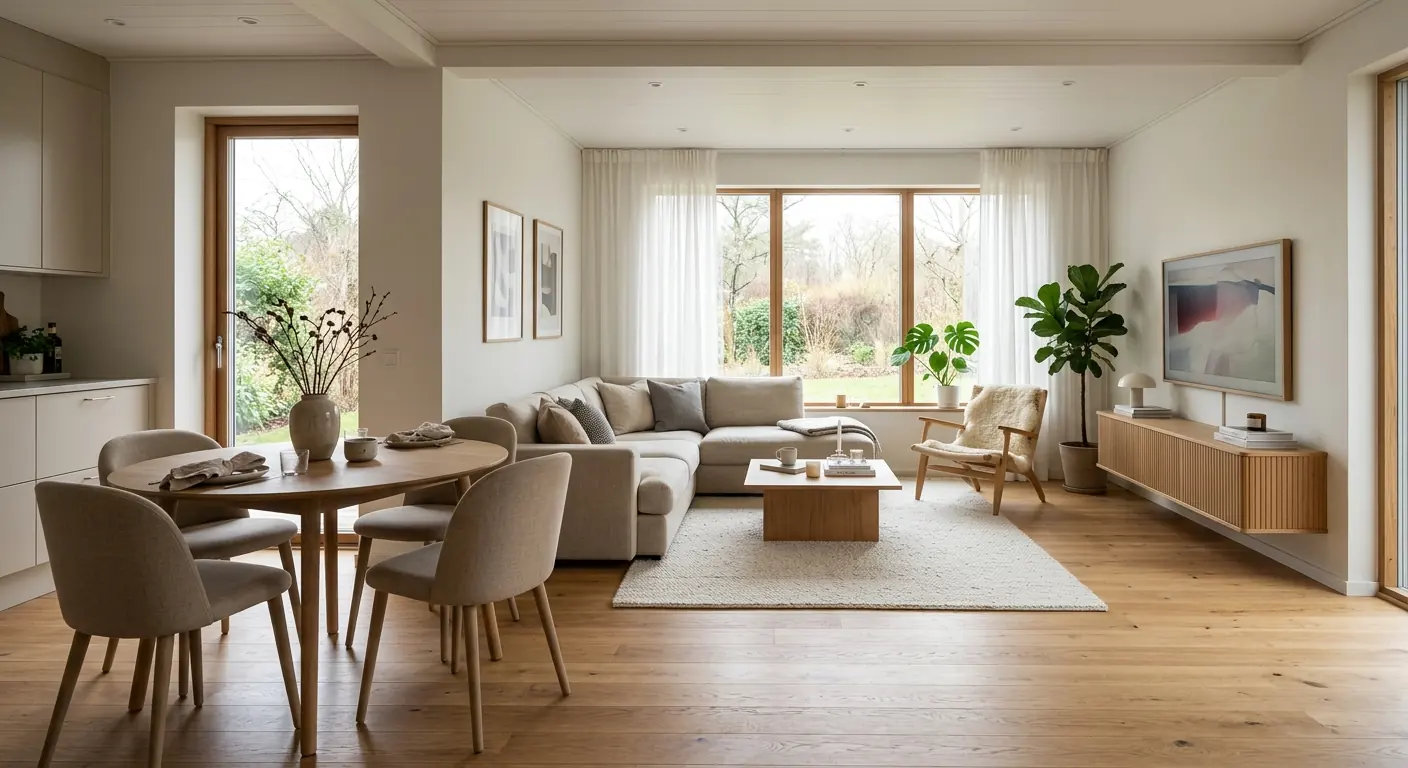
Decato
Not a render of a room — a room assembled from products, which the render is then taken of.

Fourteen tools sold as one subscription, covering architecture, exteriors, landscape and urban work as well as interiors. Sketch to Image, Masterplan, Landscape, Video Animate, Render Enhancer, Floor Plan and Room Planner sit beside the interior module. Output is metered in credits, ten per main design (Checked August 2026).
One tool for one discipline. It reads a floor plan as geometry, matches in-stock products to it, drops anything that will not clear the walls or the door swings, and prices what survives into a specification. The image is taken last, of a room that already exists as a list.
The question is not which renders better. It is whether you are buying for a practice or for a room. A studio doing exteriors, masterplans and landscape gets thirteen tools from mnml ai that Decato does not have and never will. Someone furnishing one apartment gets one thing from Decato that fourteen tools do not produce: a list with prices on it.
What each one does
Keeps a floor plan as geometry
It renders one; it does not keep the geometry
Starts from a sketch or 3D model view
The furniture in the image can be bought
Anything that does not fit is rejected
Hands over a priced list to order from
Holds the room to a budget
Exteriors, landscape and masterplans
Style library and unlimited variations
Animation and upscaling
Works on Windows or in a browser
mnml ai runs anywhere; Decato needs a Mac
Neither tool wins everywhere
mnml ai does things Decato cannot do at all. Knowing exactly where the line falls is more useful than being told one tool is better.
- Narrow on purpose: one room, furnished, against fourteen tools across four disciplines
- What comes back is a list of things to buy, not a picture to source from afterwards
- A render here is a by-product of the spec — the furniture existed before the image did
- The plan stays geometry the whole way through, so it can be revised rather than regenerated
- Exteriors, landscape, masterplans and urban work — four disciplines Decato does not enter
- Fourteen tools and 40+ architectural styles, against one visual output and no style library here
- Works from a sketch or a 3D model view, neither of which Decato accepts
- Video Animate and Render Enhancer, neither of which Decato offers in any form
- Runs in a browser on any machine, where Decato is a Mac app
What each one costs
- Free$0Unlimited planning on your own ChatGPT, Claude or Gemini key
- Pro$20/moEvery feature and every supported store, with 25 renders
- Max 5x$100/moThe same plan at 125 renders
- Max 20x$200/moThe same plan at 500 renders
- Free$0A starting allowance of credits, no card required
- Pro$29/mo
- Top tier$99/mo
These are not comparable units. mnml ai bills credits — main tools spend ten per design, auxiliary ones fewer, and unused credits roll over for up to two months — so its price buys images. Decato bills renders, and every paid tier carries the same features; the money buys volume, not capability. Annual billing discounts both.
Both price lists checked August 2026If you move across
The two overlap on interiors and nowhere else, so most of a mnml ai workflow simply stays where it is. What moves is the part that was never really rendering work.
- The style direction you settled on in mnml ai — Decato sources toward it rather than away
- Any floor plan you fed mnml ai as an image — Decato takes the same file and keeps the geometry
- A budget, which mnml ai has no use for and Decato treats as a hard constraint
- Renders made in mnml ai. Decato has no image-import pipeline; they stay where they were made
- Credits or subscription — the two are billed separately, with no migration path
- Exterior, landscape and masterplan work. Decato has no answer to any of it — keep that tool
Compare Decato against the next closest workflow.
If this page is close but not exact, use the routes below to compare Decato against staging-first, retail-first and render-first alternatives with the same decision lens.
Decato vs REimagineHome
Both source real furniture. REimagineHome fits it to a photo; Decato fits it to a dimensioned plan.
Staging-firstDecato vs Virtual Staging AI
Staging sells the photo. Decato specifies the room — real products, measured fit, a priced spec.
Service-outputDecato vs BoxBrownie
BoxBrownie sells edited images per job. Decato sources a room into a priced specification.
Retail-workflowDecato vs Wayfair
Wayfair plans your room and fills its own cart. Decato checks the fit and hands over a spec.
Most comparison tools judge the screenshot. Designers still have to deliver the room.
Decato is optimized for the step after concept approval: matching real products, checking fit, keeping the room inside budget and turning the output into a defendable package instead of a render to reverse-engineer.
Common questions
Is Decato an mnml ai alternative?
Only for one of the jobs mnml ai does. If you are rendering exteriors, landscapes or masterplans, Decato replaces nothing — it does not do any of that. If the job is furnishing an interior and handing a client something they can order, Decato covers a step mnml ai does not advertise at all.
Does mnml ai source real furniture for a room?
Its site markets rendering tools, and lists no furniture sourcing or retailer links (Checked August 2026). Decato matches real, in-stock products to the plan and writes each one into the spec with its dimensions, price and stock status.
What does mnml ai cost compared with Decato?
mnml ai runs a free tier with a starting credit allowance, then paid plans at $29 and $99 a month, billed in credits that unused balances roll over for up to two months (Checked August 2026). Decato is a free Mac download, with paid plans from $20 a month that raise render volume rather than unlock features.
How many designs do mnml ai credits actually buy?
Its help pages put the main tools at ten credits per design and the auxiliary ones at one to five, with unused credits rolling into the next month up to a two-month ceiling. Refunds are not offered; free credits to test the platform are given instead. Work the plan price back through those numbers before comparing it with anything (Checked August 2026).
Which is better for interior designers?
It depends on the deliverable. For exploring a look across many styles, or for anything outside a single interior, mnml ai does more. For a room that has to be sourced, proven to fit and handed over as a priced spec, Decato is built around that outcome and mnml ai is not.
Can I use both?
Reasonably, yes — they overlap less than the category suggests. Renders and exteriors made in mnml ai stay there, since Decato has no image import, but a brief, a budget and a floor plan carry across, and Decato picks up where the room has to become orderable.