Execution, not inspiration
Render and staging tools answer “what could this look like?”. The expensive part comes after: sourcing, checking fit, holding the budget, assembling the spec. That is the part we automate.
Decato exists for the step most tools skip: turning an approved interior into something a client can actually order. We start from a floor plan and a brief, match real in-stock products to the space, validate that they fit, hold the budget, and hand back a client-ready specification.
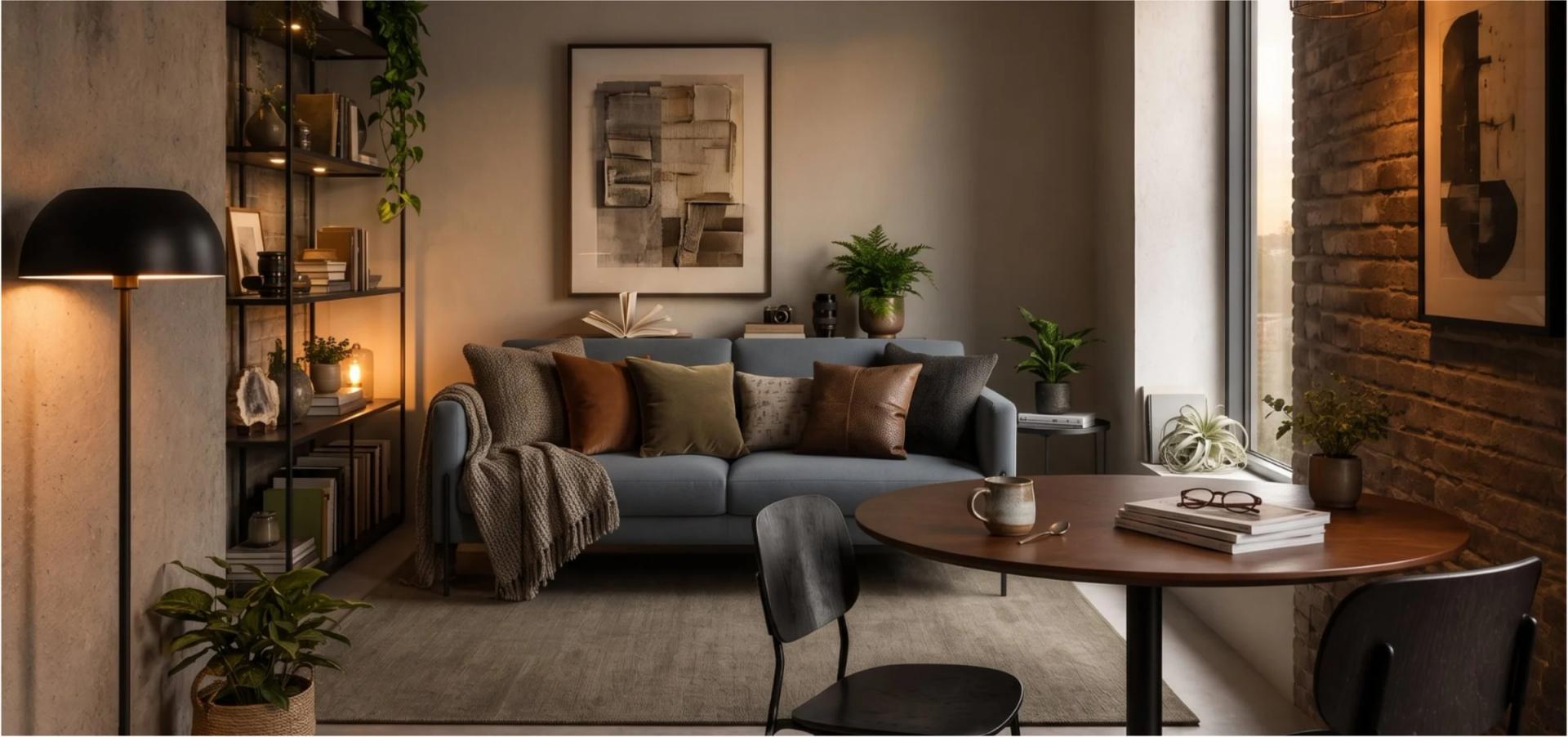
Render and staging tools answer “what could this look like?”. The expensive part comes after: sourcing, checking fit, holding the budget, assembling the spec. That is the part we automate.
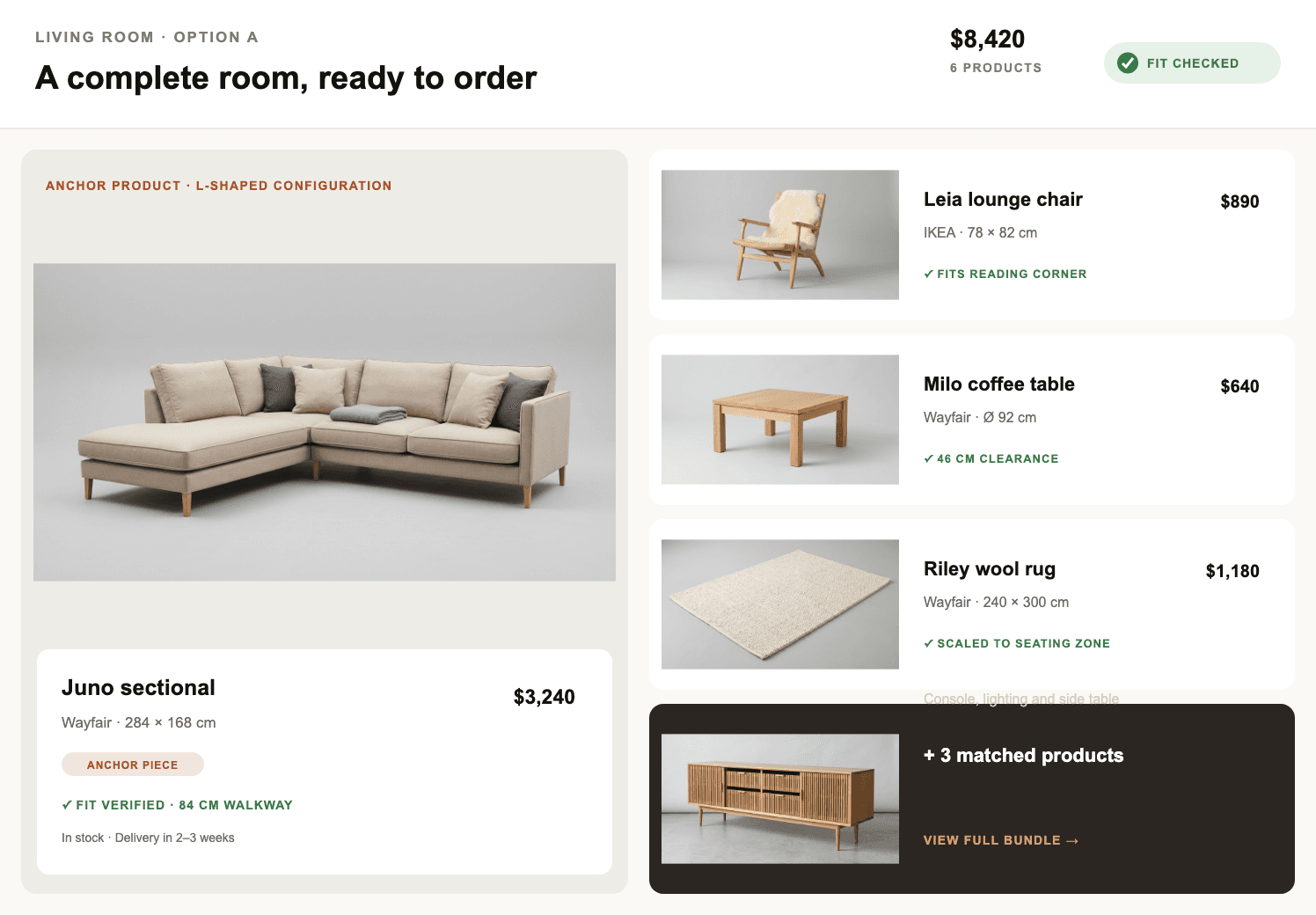
Every piece in a Decato room is an in-stock item from a real retailer, carrying its true dimensions. A render you can’t order is a picture, not a design deliverable.
The agent proposes; you direct. Every layout, swap and render stays editable, because the taste is the part worth protecting.
Interior AI, Collov, Virtual Staging AI and REimagineHome all take a room photo as input. A photograph has no dimensions in it, so nothing placed inside one can be checked against the room. Decato works from the floor plan, which means a sofa either fits between the walls or it is refused.
Rendering tools generate furniture that does not exist; Interior AI concedes in its own FAQ that outputs can contain illogical things. Every piece in a Decato room is an in-stock item from IKEA or Wayfair with its true dimensions and its current price.
Planner 5D, Wayfair Room Planner and IKEA Kreativ will all place whatever you drag in and leave the judgement to you. Decato drops anything that will not clear the walkways or the door swings before you ever see it.
The deliverable is a priced specification with a render built from those exact pieces. Staging services like BoxBrownie sell the image itself, per photo, and no product sourcing comes with it.
Programa and Fohlio run schedules, purchase orders and invoices, and both assume the specification already exists. Decato makes the specification. They sit either side of the same job and do not replace each other.
No customer count, no projects-delivered figure and no client list: we have no counter to cite for any of them, and a number we made up is worse than no number.
Checked September 2026
A desktop app for Mac and Windows that does what an interior designer does: it draws the floor plan or reads one you already have, lays out the room, picks real furniture from IKEA and Wayfair that fits both the space and the budget, and hands back a list you can order from.
Two co-founders. Aram Shakhbandaryan, previously product and growth at Google and adidas and founder of Empy, runs product and go-to-market. Vladimir Borisov, machine learning and computer vision, most recently applied AI product work at Grid Dynamics, builds the layout system and the retailer matching.
Floor planning is free and runs on your own AI subscription, so you pay your AI provider rather than us. Sourcing and renders start at $20 a month, with $100 and $200 tiers for higher volume. Everything is month to month (Checked September 2026).
No. It works from plan geometry, because a photograph carries no dimensions and a piece placed into one cannot be checked against the room. If restyling a photo is what you need, the tools named on our comparison pages do that.
No, and none is planned. Decato is a desktop app you download, for Mac and Windows.
Decato is a Delaware company. The desktop app is free to download; paid plans cover renders and sourcing volume.