
Decato vs BoxBrownie when you need a list, not an image
BoxBrownie is not really a competitor so much as a different kind of business: you send an image and a price per image, and you get an edited image back. Virtual staging, enhancement, floor plans, renders — all priced individually. Decato is software you run, and what it returns is a room specified down to the line item.

Decato
Produced by software you run, from a plan — not commissioned per image at a price per job.
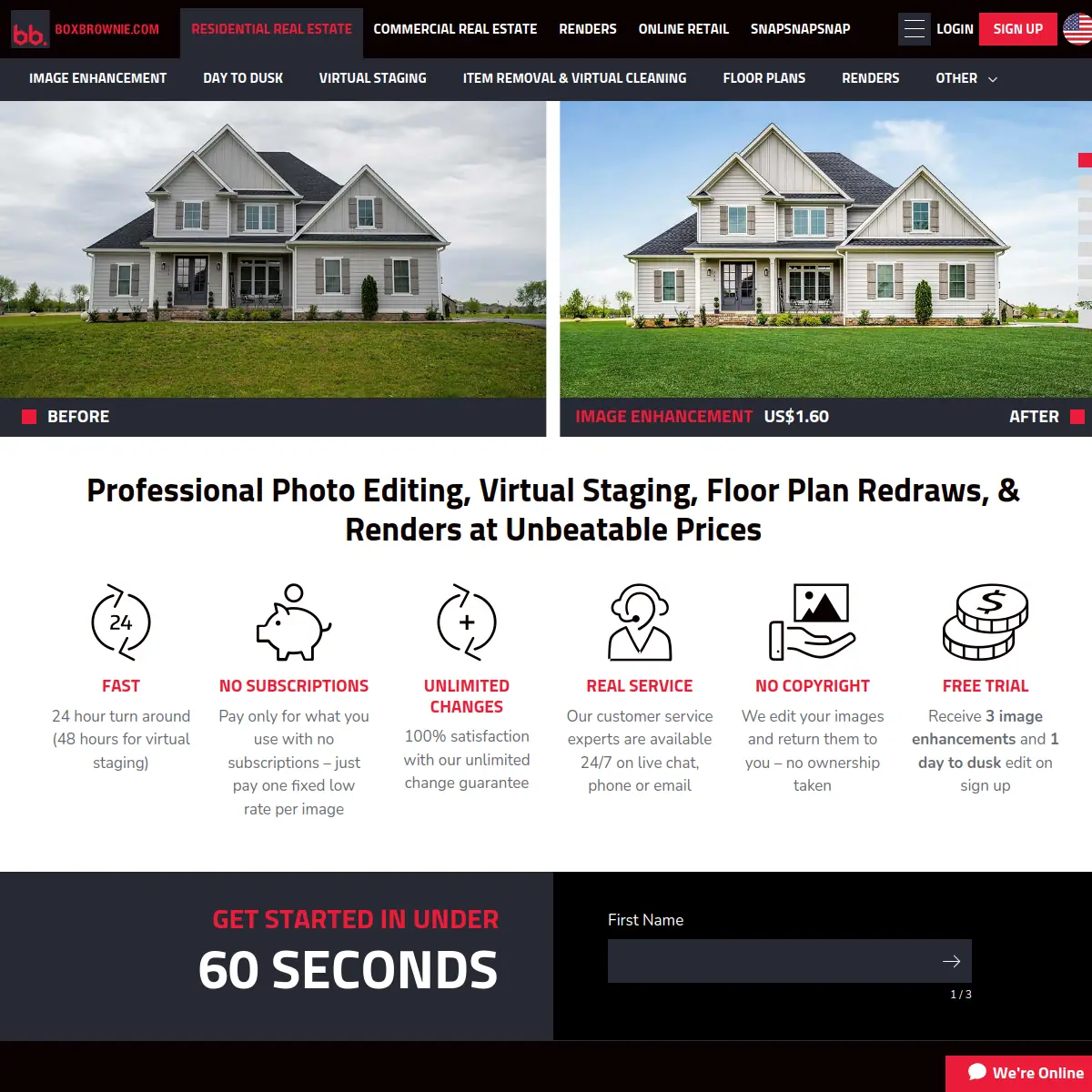
A per-job image service for property marketing. Virtual staging is priced by the photo, image enhancement by the frame, floor plans by the drawing and 3D renders by the project — so cost scales with the number of pictures, not with a monthly seat.
Software rather than a service. It runs on your machine, reads a floor plan, matches real in-stock furniture against the walls and door swings, refuses what does not fit, and returns a priced spec you own and can revise without commissioning anything.
If what you need is a handful of finished images and you would rather not make them yourself, BoxBrownie is the straightforward answer and priced accordingly. If what you need is to know which sofa, at what price, and whether it fits, no amount of image work produces that.
What each one does
Software you run yourself
Work commissioned per image
Sources real, purchasable furniture
Refuses a piece that will not fit
Priced spec a supplier can fill
Holds a furnishing budget
Photo enhancement and retouching
Drawn floor plans as a deliverable
Pay per job, with no subscription
Revise without paying again
Neither tool wins everywhere
BoxBrownie does things Decato cannot do at all. Knowing exactly where the line falls is more useful than being told one tool is better.
- You run it, so a revision costs nothing and does not have to be commissioned again
- The furniture is real inventory with dimensions and a price, not staging imagery
- A piece that will not fit is refused before anyone renders anything
- The deliverable is a specification someone can order from
- Nothing to learn and nothing to run — you send a photo and get one back
- Priced per job, so an occasional need never becomes a subscription
- Covers image work Decato does not attempt: enhancement, 360° staging, drawn floor plans
- Purpose-built for property marketing, with pricing that reflects it
What each one costs
- Free$0Plan without limit on your own ChatGPT, Claude or Gemini key
- Pro$20/moSourcing from every supported store, and 25 renders a month
- Max 5x$100/moSame capability, 125 renders
- Max 20x$200/moSame capability, 500 renders
- Virtual staging$30Per residential photo; $60 for 360°
- Image enhancement$2Per image; $5 for 360°
- Floor plans$30–$40Per plan, 2D black and white through to 3D colour
- 3D renders$350+$500 aerial streetscape, $750 for large projects
These price different things, so the comparison only works at the level of a project. A handful of staged photos costs less through BoxBrownie than a month of Decato, and requires nothing of you. A room specified and priced is not something BoxBrownie sells at any price. Their pricing page does not state turnaround times or whether editing is done by hand, so we do not characterise either.
Both price lists checked August 2026If you move across
This is not really a switch: one is commissioned image work and the other is software you run. The question is which of the two a given project actually needs.
- A floor plan BoxBrownie drew for you — Decato imports it and traces it into geometry
- The staged look a client approved, as the style brief Decato sources toward
- A furnishing budget, which a per-image service has no reason to ask about
- Edited or staged images — Decato has no image import and no retouching pipeline
- The service model itself: Decato is software you operate, not work you commission
- Enhancement, 360° staging or drawn floor plans, none of which Decato produces
Compare Decato against the next closest workflow.
If this page is close but not exact, use the routes below to compare Decato against staging-first, retail-first and render-first alternatives with the same decision lens.
Decato vs REimagineHome
Both source real furniture. REimagineHome fits it to a photo; Decato fits it to a dimensioned plan.
Staging-firstDecato vs Virtual Staging AI
Staging sells the photo. Decato specifies the room — real products, measured fit, a priced spec.
Retail-workflowDecato vs Wayfair
Wayfair plans your room and fills its own cart. Decato checks the fit and hands over a spec.
Consumer-visualizationDecato vs IKEA Kreativ
Kreativ furnishes your scanned room from IKEA. Decato adds Wayfair, checks fit and writes a spec.
Most comparison tools judge the screenshot. Designers still have to deliver the room.
Decato is optimized for the step after concept approval: matching real products, checking fit, keeping the room inside budget and turning the output into a defendable package instead of a render to reverse-engineer.
Common questions
Is BoxBrownie a Decato competitor?
Barely. BoxBrownie sells finished images per job and Decato is software that specifies a room; the two overlap only in that both end up with a picture of an interior. Where they genuinely differ is that one tells you what the furniture is and the other does not.
Can BoxBrownie tell me what furniture to buy?
No. Its services are image work — staging, enhancement, floor plan drawings, renders — and no product sourcing is offered (Checked August 2026). The furniture in a staged photo is there to make the room read well, not to be ordered.
Which is cheaper?
It depends entirely on volume and on what you need. A few staged photos cost less than a month of Decato and require nothing of you. A specified, priced room is not something BoxBrownie sells, so beyond a certain point the comparison stops being about price.
How fast is each one?
BoxBrownie does not publish turnaround times on its pricing page, so we will not claim a figure (Checked August 2026). What can be said is structural: commissioned work involves a queue and a hand-off, while software you run answers as fast as you can operate it — and revisions cost nothing.
Can I use both?
Reasonably. A floor plan drawn by BoxBrownie imports into Decato as an image and gets traced into geometry, and staging can carry the marketing side while Decato handles the sourcing. Nothing transfers automatically in either direction.