Decato vs ArchiVinci when the room has to be ordered
ArchiVinci sells renders and sells them generously — unlimited, across interiors, exteriors, bird-eye views, landscapes and masterplans, from a sketch or a 2D floor plan. Decato renders far less and sources instead: its output is a list of real products, each measured against your walls and carrying a price.
Decato
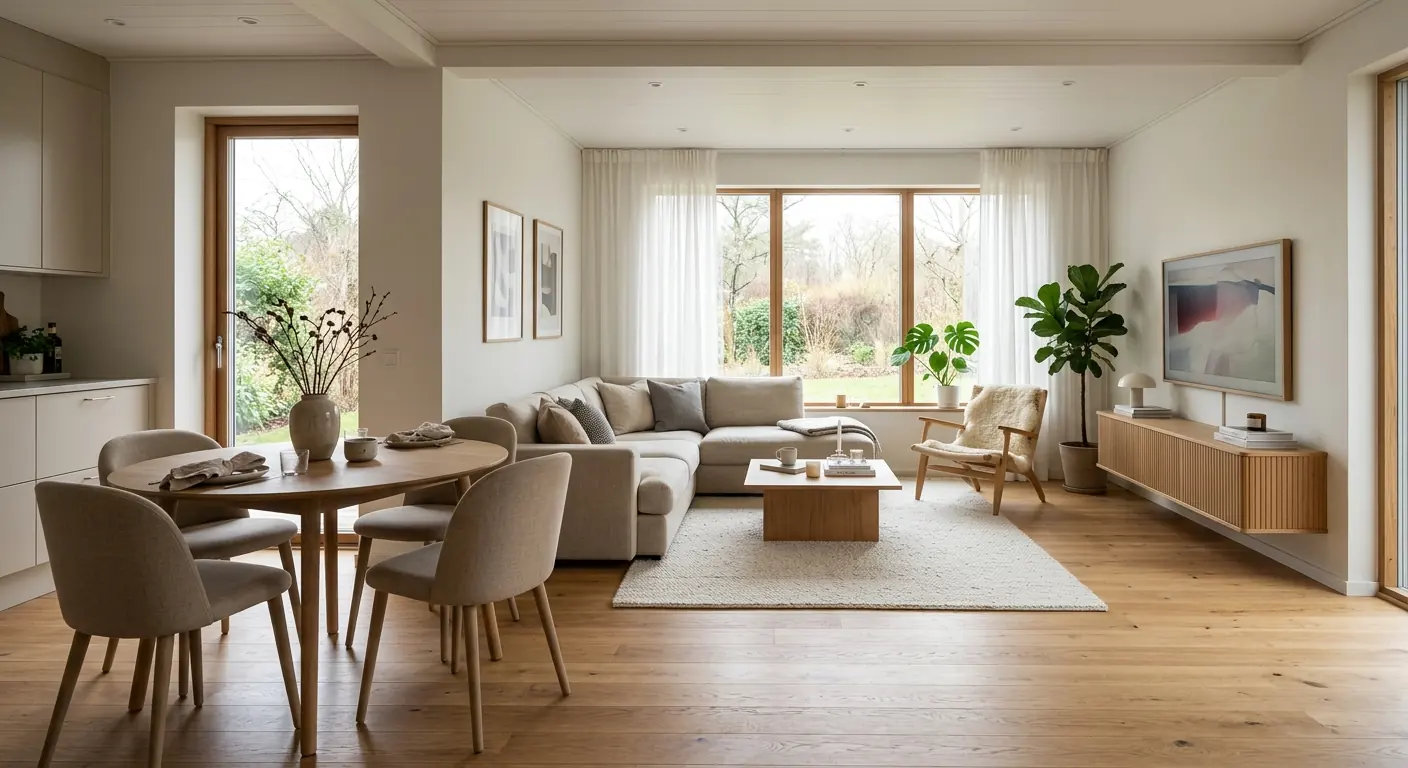
Rendered once, from a room that already had a price and a parts list attached to it.

A rendering platform with unusually wide scope and an unusually generous plan: unlimited renders across interiors, exteriors, bird-eye, landscape and masterplan work, plus video and HDRI maps, sold weekly, monthly, yearly or as a one-time pass with a coin allowance on top.
A tool that treats the render as the last step rather than the product. It reads a floor plan as geometry, matches in-stock furniture against the real walls and door swings, refuses what will not fit, and hands back a priced spec with the image attached to it.
If you need pictures — of an interior, a facade, a masterplan, in volume and in many styles — ArchiVinci gives you more of them for the money than Decato possibly could. If someone has to buy the furniture in the picture, ArchiVinci advertises nothing that would tell them what to buy.
What each one does
Furnishes a 2D floor plan
Both accept one; only Decato keeps it measured
Works from a rough sketch
The furniture can be bought
A piece that does not fit is refused
Priced list a supplier can fill
Holds a furnishing budget
Exteriors, landscape and masterplans
Unlimited renders
Video and HDRI output
Buy once instead of subscribing
Passes from three days to a year
Neither tool wins everywhere
ArchiVinci does things Decato cannot do at all. Knowing exactly where the line falls is more useful than being told one tool is better.
- The render is downstream of a real parts list, so what you present is what you can order
- Wall lengths and door swings decide the layout, rather than being suggested by it
- A price attaches to every piece the moment it enters the room
- The project stays editable, so a client changing their mind is a revision, not a re-render
- Unlimited renders on every subscription — Decato meters them and always will
- Exteriors, landscape and masterplans, none of which Decato attempts
- Video generation and HDRI maps, which have no equivalent in Decato at all
- Buyable as a one-time pass, so a single project need not become a subscription
- Takes a sketch as input, where Decato insists on a measured plan
What each one costs
- Free$0Plan without limit on your own ChatGPT, Claude or Gemini key
- Pro$20/moSourcing from every supported store, with 25 renders a month
- Max 5x$100/moThe same capability at 125 renders
- Max 20x$200/moThe same capability at 500 renders
- Weekly$39/wkUnlimited renders plus 20 coins
- Monthly$79/moUnlimited renders plus 40 coins
- Yearly$549/yrAbout $46 a month, plus 500 coins
- One-time$49–$599Three-day to one-year passes, no subscription
ArchiVinci is dearer per month and cheaper per image, because renders are unlimited on every tier and only its coin-metered tools are rationed. Its one-time passes are genuinely useful for a single project, and Decato has no equivalent. Decato costs less and meters renders, but the money is buying a sourced room rather than a picture — which is why the per-image comparison flatters ArchiVinci and misses the point.
Both price lists checked August 2026If you move across
Everything ArchiVinci does outside a furnished interior has no equivalent here, so keep it for that. Only the interior work has anywhere to move to.
- A 2D floor plan you already furnished in ArchiVinci — Decato re-reads it as geometry
- The scheme a client picked from the renders, as the style brief Decato sources toward
- A furnishing budget, which ArchiVinci has no field for and Decato treats as a ceiling
- Renders, video or HDRI output — Decato has no image import and no video pipeline
- Exterior, landscape and masterplan work, which is outside Decato entirely
- Coins or passes: the two are billed separately, with no migration between them
Compare Decato against the next closest workflow.
If this page is close but not exact, use the routes below to compare Decato against staging-first, retail-first and render-first alternatives with the same decision lens.
Decato vs REimagineHome
Both source real furniture. REimagineHome fits it to a photo; Decato fits it to a dimensioned plan.
Staging-firstDecato vs Virtual Staging AI
Staging sells the photo. Decato specifies the room — real products, measured fit, a priced spec.
Service-outputDecato vs BoxBrownie
BoxBrownie sells edited images per job. Decato sources a room into a priced specification.
Retail-workflowDecato vs Wayfair
Wayfair plans your room and fills its own cart. Decato checks the fit and hands over a spec.
Most comparison tools judge the screenshot. Designers still have to deliver the room.
Decato is optimized for the step after concept approval: matching real products, checking fit, keeping the room inside budget and turning the output into a defendable package instead of a render to reverse-engineer.
Common questions
Is Decato an ArchiVinci alternative?
For interiors that have to be bought, yes. For everything else ArchiVinci does — exteriors, landscape, masterplans, video — Decato replaces nothing, because it does none of it. The overlap is one room, furnished, and even there the two produce different things: ArchiVinci an image, Decato a list.
Does ArchiVinci source real furniture?
Its site markets rendering, and advertises no furniture sourcing or retailer links (Checked August 2026). The furniture in an ArchiVinci render is generated into the image. Decato works from live retailer inventory, so every piece arrives with dimensions, a price and a stock status already attached.
ArchiVinci gives unlimited renders. Why does Decato meter them?
Because a Decato render is the last step of sourcing an entire room rather than a single image generation, and it costs accordingly. The honest comparison is not renders against renders: on volume of pictures ArchiVinci wins outright, and if pictures are the deliverable it is the better buy.
Can I furnish a floor plan in both?
Yes — ArchiVinci lists furnishing 2D floor plans as a feature, and Decato requires a plan to start (Checked August 2026). The difference is what happens to it: ArchiVinci renders the plan into a picture, while Decato keeps it as measurements and checks every piece against them.
Which is better for a one-off project?
ArchiVinci, on structure alone — it sells passes from three days to a year, so a single project does not become an ongoing subscription. Decato has no one-time option. If that project ends in a purchase order rather than a presentation, the calculation changes.